

Local News Crime Coverage in Canadian Cities: What Changed and What to Watch in 2026
9 min read
Crime reporting doesn’t simply document what happens on our streets. It actively constructs how safe we believe those streets to be. In Canadian cities, three reporting mechanisms now shape public perception more than actual crime rates: the volume of coverage relative to statistical frequency, the geographic framing that creates “hotspot” narratives, and the language choices that anchor fear or reassurance. Statistics Canada reported that both the rates and severity of reported crime dropped almost across the board in 2025, with the crime severity index down five per cent and the conventional crime rate falling two per cent. Yet surveys consistently reveal a widening gap between measured crime and perceived safety, a divergence researchers trace directly to how local newsrooms select, frame, and present criminal incidents.
This tension matters because perception drives real consequences. Neighbourhoods branded as dangerous face property devaluation and reduced investment. Residents alter daily routines, avoiding public transit or evening walks based on amplified threat narratives rather than actual risk. The Macdonald-Laurier Institute’s fourth Justice System Report Card, released in March 2026, underscores how public confidence in safety influences policy priorities and resource allocation. Understanding the shaping mechanisms behind these perceptions equips communities to interpret crime coverage critically and demand reporting practices that reflect statistical reality alongside compelling storytelling.
What Changed: Crime Statistics vs. Public Perception in 2025
Canada experienced a measurable improvement in public safety during 2025, yet many residents remain convinced their communities have become less secure. According to Statistics Canada crime severity data, the country’s crime severity index dropped five per cent last year, while the conventional crime rate fell two per cent. Both metrics represent meaningful declines in reported criminal activity across nearly all categories tracked by federal authorities.
Despite these positive trends, polling and community discourse reveal persistent worry about neighbourhood safety, particularly in urban centres. Residents continue to cite crime as a primary concern when discussing quality of life, even in areas where statistical risk has demonstrably decreased. This disconnect between measurable safety improvements and lived perception points to a critical mediating factor: the way crime stories are selected, framed, and distributed by local news outlets. The volume and nature of crime reporting shapes how Canadians understand their communities’ safety far more powerfully than raw statistics ever could, creating a perception gap with real consequences for policy, policing priorities, and community cohesion.
Key Developments Shaping Safety Perceptions

1. Volume and Frequency of Crime Coverage
The volume of crime coverage in Canadian news media operates independently from actual crime trends, creating a perception amplifier that shapes how communities understand their safety. Even as Statistics Canada reported that both crime rates and severity declined in 2025, with the crime severity index down five per cent and the conventional crime rate down two per cent, many Canadians felt less safe in their neighborhoods. This disconnect stems not from an increase in criminal activity, but from the steady drumbeat of crime stories that fill local news cycles regardless of statistical reality.
Newsroom selection bias plays a central role in this volume effect. Crime stories meet multiple editorial needs simultaneously: they generate reader engagement, require minimal investigative resources compared to complex policy reporting, and provide a reliable content stream to fill daily news holes. The traditional newsroom maxim “if it bleeds, it leads” persists because crime coverage delivers predictable audience attention. This creates a feedback loop where the editorial decision to prioritize crime stories reinforces public perception that crime is prevalent, which in turn justifies more crime coverage.
The sheer repetition of crime reports creates several specific perception effects:
- Repetition makes isolated incidents feel like a pattern, inflating perceived frequency beyond statistical reality
- The availability heuristic causes recent crime stories to dominate mental risk calculations, overriding actual probability
- Geographic clustering of coverage creates hotspot narratives even when incidents are statistically dispersed
- Emphasis on certain crime types (violent crime, property crime) distorts overall safety assessments of entire communities
Research from the Canadian Policing Research Catalogue examining cognitive fear maps demonstrates how this volume effect translates media exposure into spatial perceptions of danger. When residents are repeatedly exposed to crime coverage from specific areas, they develop mental maps of threat that may bear little relationship to actual crime data for those locations. The coverage volume itself becomes the signal, teaching communities where to feel unsafe independent of their own experiences or statistical risk.
2. Geographic Framing and Neighborhood Stigmatization
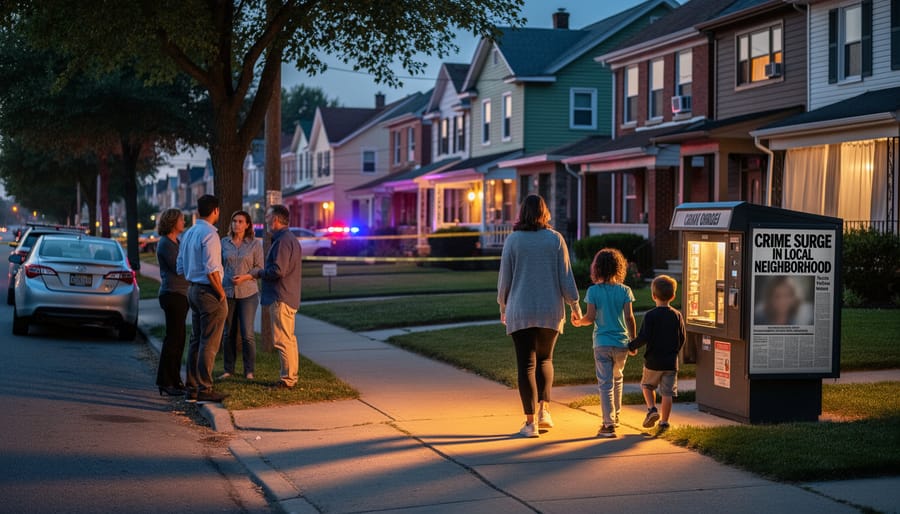
Crime reporting doesn’t just document incidents, it stamps lasting safety labels onto entire neighborhoods. When a journalist covers a break-in on one block or an assault in a specific park, the story often becomes shorthand for the whole area in readers’ minds. Over time, these individual reports accumulate into what researchers call cognitive fear maps: mental geographies where certain neighborhoods register as dangerous regardless of their actual crime rates.
This phenomenon matters because the labels stick. Research by Spicer, Song, and Brantingham documented how businesses form fear-based perceptions of specific areas based on reported incidents, creating cognitive maps that rarely update when conditions improve. A Toronto neighborhood with a string of car thefts covered prominently in 2023 may still carry the “unsafe” tag in 2026, even if those incidents dropped sharply in 2025 when Canada’s overall crime severity index fell five per cent.
The consequences ripple outward. Property values respond to perceived safety as much as to actual crime statistics. Community investment, both public infrastructure and private business, flows away from stigmatized areas. Residents internalize the narrative, which shapes everything from where they walk at night to how they describe their own neighborhood to outsiders. Parents choose schools, employers locate offices, and renters make housing decisions all filtered through these cognitive maps.
The disconnect grows when reporting concentrates on a few high-profile locations while ignoring statistically similar incidents elsewhere. Crime becomes the defining characteristic of certain communities in the news, while other areas, sometimes with comparable or higher crime rates, remain unmarked on the public’s mental map. The story selection process itself creates the geography of fear, independent of where danger actually lies.
3. Language and Context in Crime Narratives

The words journalists choose and the context they provide, or omit, determine whether readers interpret a crime story as a signal of broader danger or an isolated event. A headline reading “Violent Assault Downtown” triggers a different psychological response than “Assault Reported in Area Where Crime Rate Has Declined 15 Percent Since 2023,” yet both describe the same incident. The second version grounds the event in statistical reality; the first lets it stand alone, prompting readers to fill gaps with assumptions shaped by accumulated fear rather than data.
When newsrooms present individual crimes without situating them within larger trends, each report becomes a data point that readers aggregate into a personal threat assessment. A robbery in Leslieville, a break-in in Mount Pleasant, a carjacking in North York, reported separately across weeks without reference to overall crime patterns, constructs a narrative of escalating danger in readers’ minds, even when citywide statistics show the opposite. This cumulative effect operates below conscious awareness. Readers rarely pause to ask whether five reported incidents over three months represents an increase or decrease from previous years, or whether it reflects a comprehensive picture or a selective slice of newsroom attention.
Context-rich reporting that places incidents within statistical frameworks, geographic patterns, and historical comparisons allows readers to calibrate their response appropriately. Yet this approach requires additional reporting time, access to police data, and a willingness to sacrifice the immediate engagement that sensational, context-free headlines generate. The gap between what happened and what readers believe is happening widens with every report that omits the qualifier: crime remains far less common than coverage volume suggests.
Why It Matters: The Real-World Impact on Canadian Communities
The gap between statistical safety and perceived danger translates directly into how Canadian communities function, from city budgets to daily behavior. When news coverage amplifies crime beyond its actual prevalence, elected officials face constituent pressure to increase policing budgets even as crime rates decline. Toronto City Council fielded multiple public safety funding requests in 2025 despite the two per cent drop in conventional crime that year, illustrating how perception drives policy independent of data.
This misalignment reshapes resource allocation across jurisdictions. Police services redirect officers to high-visibility patrols in neighborhoods flagged by coverage rather than deploying based purely on incident patterns. Community centers in areas repeatedly featured in crime stories struggle to attract programming funding, while residents avoid public spaces they now associate with danger. The Macdonald-Laurier Institute’s March 2026 Justice System Report Card measured public confidence in justice outcomes, providing a benchmark for how Canadians evaluate system performance against their perception-shaped expectations.
Social cohesion suffers when reporting creates cognitive fear maps that override lived experience. Residents internalize narratives about their own neighborhoods, altering commuting routes, limiting children’s outdoor activity, and withdrawing from community engagement. Property values respond to perceived rather than actual risk, concentrating disinvestment in already-marginalized areas. Meanwhile, understanding how coverage shapes these perceptions requires looking beyond individual news stories to examine broader patterns, similar to how a media bias chart reveals systemic tendencies across outlets.
For Toronto and other Canadian cities, closing the perception-reality gap matters because sustained misalignment erodes both effective governance and community trust. When residents believe their streets are dangerous despite improving safety metrics, evidence-based policy becomes politically untenable, and genuine progress goes unrecognized.
What to Watch: Evolving Approaches to Crime Reporting
Canadian newsrooms face mounting questions about how they cover crime stories. Several news organizations have begun experimenting with context-rich reporting that pairs individual incidents with statistical trends, while others still default to isolated crime stories that omit broader safety data. Digital platforms fragment crime narratives in unpredictable ways, hyperlocal community forums and social media amplify certain incidents while burying others, sometimes reinforcing the very perception gaps that data-driven journalism aims to close.
The shift toward community-focused models remains patchy. Some outlets now consult neighborhood groups before framing stories about specific areas, while others continue patterns that stigmatize certain communities regardless of whether crime rates there are rising or falling. Transparency tools like media bias checkers help readers evaluate coverage choices, but newsroom standards for contextualizing crime remain inconsistent across Canadian markets.
How can readers tell if crime reporting reflects reality?
Compare reported incidents to official statistics like the crime severity index, check whether stories provide context about trends rather than isolated events, and notice if coverage focuses disproportionately on certain neighborhoods.
What should responsible crime coverage include?
Responsible reporting pairs individual incidents with statistical context, explains whether an event represents a trend or an anomaly, and avoids language that assigns permanent threat labels to entire communities.
How do perception studies inform better journalism?
Research like cognitive fear mapping shows how coverage patterns create mental safety maps disconnected from data, guiding newsrooms to contextualize stories and avoid amplifying fear through volume alone.
The journalism challenge ahead is less about eliminating crime coverage than about rebuilding the relationship between reporting and reality. Newsrooms that succeed will treat crime stories as data points within larger safety narratives, not standalone events demanding breathless framing. Whether Canadian cities see this shift broadly or only in pockets depends on how news organizations balance reader engagement with accuracy, a tension that remains unresolved heading into 2026.
Local news crime reporting stands as the dominant force shaping how most Canadians understand safety in their communities, often wielding more influence over public perception than crime statistics themselves. Despite Statistics Canada confirming that both crime rates and severity dropped in 2025, the gap between measurable safety improvements and lived concern persists precisely because coverage acts as the primary filter through which communities interpret risk. This disconnect carries real consequences for policy priorities, resource allocation, and the social fabric of neighborhoods across Canadian cities.
News organizations bear a clear responsibility to provide statistical context alongside crime coverage, framing individual incidents within broader trends rather than presenting them as isolated threats. Readers, in turn, must develop critical media literacy around crime narratives, recognizing how volume, geographic framing, and language choices can distort the statistical reality of community safety. The same analytical approach applied to Burlington local news or coverage in any Canadian city reveals these shaping mechanisms at work.
Improving this relationship benefits both journalism and the communities it serves. Thoughtful crime reporting that balances urgency with context builds trust, informs rather than alarms, and equips citizens to engage meaningfully with public safety challenges. When coverage aligns more closely with measurable trends, it strengthens both democratic decision-making and the credibility of local news itself.