
Toronto Culture Thrives Beyond the CN Tower: What Locals Actually Experience
12 min read
Toronto’s cultural landscape defies easy categorization. More than 200 ethnic groups converge in neighborhoods where Somali restaurants neighbor Vietnamese bakeries, where Mandarin echoes through subway cars alongside Tagalog and Portuguese. This diversity shapes a city where cultural events function less as tourist spectacles and more as genuine expressions of community identity—though distinguishing authentic celebration from commercial appropriation requires discernment.
Understanding Toronto culture means examining what happens when traditional practices meet urban realities. The Caribbean Carnival draws millions, yet its evolution from grassroots celebration to municipally managed festival reflects broader tensions between cultural preservation and civic branding. Indigenous art installations in corporate towers raise questions about reconciliation versus tokenism. Chinatown’s Mid-Autumn Festival exists alongside gentrification pressures that threaten its continuity.
This complexity matters because Toronto’s cultural identity remains unfinished. Unlike cities with centuries-old traditions, Toronto continually negotiates what it means to be itself. Recent immigrants shape cultural norms as much as established institutions. Underground music scenes challenge mainstream narratives. Community organizations fight to maintain cultural spaces against economic pressures.
The following analysis moves beyond event listings to examine how Toronto’s cultural moments reveal deeper truths about belonging, power, and identity in Canada’s largest metropolis. Understanding these dynamics illuminates not just what Toronto celebrates, but why certain voices dominate while others struggle for recognition.
The Mosaic Reality: How Immigration Shapes Toronto’s Cultural DNA
Toronto’s cultural identity emerges from successive waves of immigration that have fundamentally transformed the city over more than a century. According to Demographics of Toronto, more than half the city’s population was born outside Canada, making it one of the most diverse urban centers globally. This demographic reality extends beyond statistics into the fabric of daily life, where dozens of languages animate streetscapes and cultural practices coexist in remarkably fluid ways.
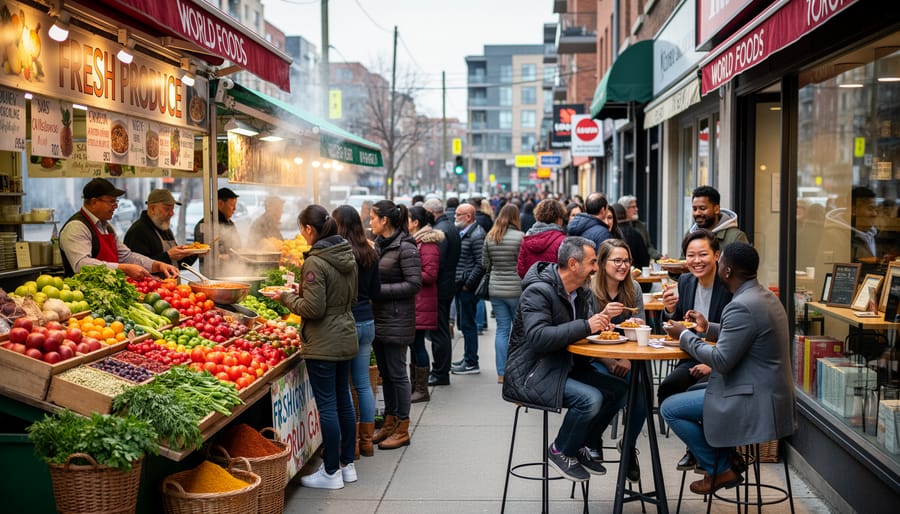
The city’s neighborhoods serve as living archives of immigration history. Little Italy, Greektown, Koreatown, and Little Portugal reflect earlier 20th-century arrivals, while Thorncliffe Park, Flemingdon Park, and parts of Scarborough embody more recent demographic shifts from South Asia, the Middle East, and East Africa. These aren’t museum pieces or tourist attractions but functioning communities where cultural retention and adaptation occur simultaneously. A Portuguese bakery might stand beside a Vietnamese pho restaurant, both patronized by third-generation Canadians and newcomers alike.
This diversity manifests tangibly in everyday experiences. Public school classrooms routinely serve students speaking 30 or more home languages. Transit riders encounter conversations in Tagalog, Mandarin, Tamil, and Polish within minutes. Strip malls become cultural crossroads where halal butchers, Caribbean roti shops, and Eastern European delis operate side by side, their proximity normalized rather than exotic.
The city’s approach to cultural expression differs markedly from traditional melting pot models. Toronto’s often-cited mosaic metaphor suggests distinct pieces maintaining individual character while contributing to a larger whole. Community celebrations demonstrate this principle: Caribana, the Toronto International Film Festival, Taste of the Danforth, and Lunar New Year festivities don’t merely showcase individual cultures but invite cross-cultural participation and dialogue.
Yet this mosaic isn’t without friction. Questions persist about gentrification displacing cultural communities, whether established neighborhoods can maintain character amid demographic turnover, and how authenticity is preserved or commercialized. The tension between celebration and commodification remains an ongoing conversation, as does ensuring newcomer communities receive adequate resources while maintaining cultural connections.
What emerges is something more complex than simple multiculturalism—a constantly negotiated reality where cultural boundaries blur, hybrid identities flourish, and the definition of “Toronto culture” itself remains perpetually in flux.
Beyond Festivals: The Everyday Cultural Rhythms of the City
Neighborhood Cultural Hubs
Toronto’s cultural identity exists not as a singular narrative but as a collection of distinct neighborhood ecosystems, each maintaining its own traditions, languages, and community rhythms. These areas function as more than tourist destinations—they represent living, breathing communities where cultural practices evolve organically through daily interaction rather than staged performance.
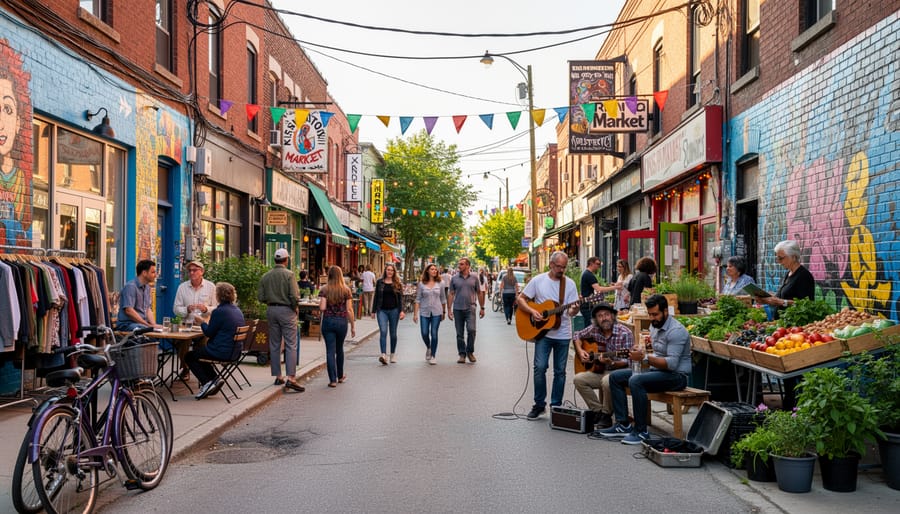
Kensington Market exemplifies this organic cultural development. What began as a Jewish market in the early 20th century has transformed through successive waves of immigration into a bohemian enclave where Portuguese bakeries sit beside Caribbean patty shops and vintage clothing stores. The neighborhood resists gentrification through community organizing, maintaining its character as an accessible space for new immigrants and artists alike.
Little India along Gerrard Street East demonstrates how diaspora communities create anchor points for cultural continuity. Beyond the sari shops and sweet centers, the neighborhood serves as a social infrastructure where recent immigrants access services in familiar languages, celebrate festivals like Diwali with authentic rituals, and maintain connections to regional Indian traditions that might otherwise fade in a new country.
Each neighborhood offers distinct cultural characteristics:
- Greektown (The Danforth) – annual Taste of the Danforth festival, traditional tavernas, and Greek Orthodox community institutions
- Chinatown (Spadina Avenue) – herbalist shops, dim sum culture, and multi-generational family businesses
- Little Portugal (Dundas West) – community soccer culture, family-run churrasqueiras, and Nossa Senhora de Fátima processions
- Koreatown (Christie-Bloor) – 24-hour restaurants, karaoke culture, and Korean beauty retailers
These neighborhoods challenge the notion of multiculturalism as mere coexistence. They reveal how cultural preservation requires physical space, economic sustainability, and intergenerational knowledge transfer. As real estate pressures mount, these cultural hubs face questions about their future—whether community practices can survive rising rents and demographic shifts, or whether Toronto’s neighborhood diversity will gradually homogenize into a more sanitized cultural experience.
The Underground Arts Movement
Beyond the established galleries of Yorkville and the Distillery District, Toronto’s underground arts scene thrives in repurposed industrial spaces, artist-run centres, and temporary installations that resist commercial pressures. Organizations like XPACE Cultural Centre and Trinity Square Video have provided platforms for experimental work since the 1970s, while newer collectives such as Papirmasse and The Bentway continue this tradition of community-driven cultural production.
These spaces serve as incubators for artists whose work challenges dominant narratives around identity, gentrification, and social justice. Independent galleries in neighbourhoods like Parkdale and Little Portugal operate on modest budgets, prioritizing accessibility and artistic risk-taking over market viability. Artist collectives frequently organize guerrilla exhibitions in vacant storefronts, transforming overlooked urban spaces into temporary cultural hubs that engage directly with neighbourhood concerns.
The underground movement also encompasses performance spaces hosting everything from experimental theatre to spoken word events that center marginalized voices. This network of alternative venues creates opportunities for emerging artists while fostering critical dialogue about Toronto’s rapid development and its impact on creative communities. These grassroots initiatives reveal a cultural landscape far more diverse and contentious than official celebrations suggest, offering authentic engagement with the city’s evolving identity.
Toronto Cultural Events: The Annual Calendar That Defines Us
How Events Reflect Community Priorities
Toronto’s cultural funding landscape reveals clear patterns about which communities hold institutional power. The TAC funds festivals annually, yet legacy events like the Toronto International Film Festival and Luminato consistently attract the largest public and private investment, while grassroots cultural celebrations in racialized communities often rely on volunteer labour and precarious year-to-year grants. This disparity speaks volumes about whose stories are deemed worthy of sustained institutional support.
Media coverage follows similar hierarchies. Caribana, despite drawing over a million participants, historically received less extensive year-round coverage compared to smaller but more institutionally connected events. Recent shifts toward equity-focused journalism have begun addressing these imbalances, though significant gaps remain in who gets to tell these stories and how they’re framed.
Community participation patterns offer a different measure entirely. While attendance at major festivals provides one metric, sustained engagement reveals deeper priorities. Neighbourhood cultural hubs in areas like Parkdale, Little Jamaica, and Thorncliffe Park demonstrate vibrant cultural production that operates largely outside mainstream recognition, sustained by communities investing their own resources and time.
The tension between corporate-sponsored spectacle and community-driven celebration highlights fundamental questions about cultural authenticity. Events requiring substantial sponsorship inevitably shape programming to appeal to broader, often whiter and wealthier, demographics. Meanwhile, smaller cultural gatherings preserve traditions and create space for expression that resists commodification, though their survival remains perpetually uncertain without equitable funding structures that recognize cultural production beyond economic returns.
The Economic and Social Impact
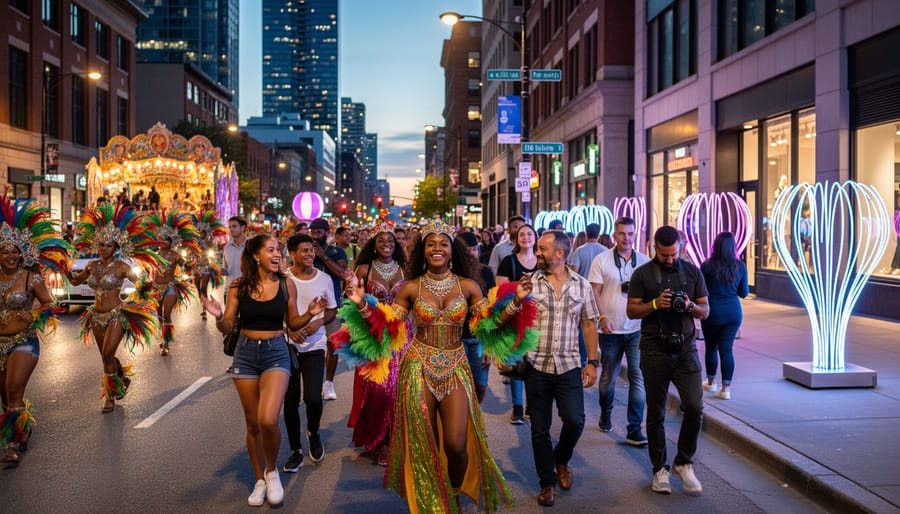
Cultural events in Toronto function as multifaceted engines that extend far beyond weekend entertainment, driving substantial economic activity while simultaneously shaping the city’s social fabric. Toronto’s visitor economy benefits significantly from major festivals and cultural programming, generating millions in direct revenue through ticket sales, accommodation, and dining, while creating employment opportunities across hospitality, production, and creative sectors. The Caribbean Carnival alone attracts over one million attendees annually, demonstrating how cultural celebrations translate into measurable economic impact for local businesses and service providers.
Beyond balance sheets, these events serve as essential community-building mechanisms that facilitate dialogue across Toronto’s diverse populations. Neighbourhood festivals create spaces where newcomers and established residents interact organically, fostering social cohesion in ways that formal integration programs cannot replicate. Cultural programming at venues like the Harbourfront Centre provides platforms for artists to address pressing social issues—from housing affordability to systemic discrimination—transforming performance spaces into forums for civic discourse.
The intersection of economic and social functions becomes particularly evident in how cultural events can either reinforce or challenge existing power structures. Community-led initiatives in areas like Parkdale or Regent Park use cultural programming to assert neighbourhood identity and resist displacement pressures, turning festivals into statements of belonging and resistance. Meanwhile, large-scale corporate-sponsored events raise questions about authenticity and access, highlighting tensions between cultural celebration as public good versus commercial venture.
This dual nature reflects Toronto’s ongoing negotiation of cultural identity—balancing economic pragmatism with genuine community expression, where success increasingly depends on ensuring that cultural programming enriches both municipal coffers and civic life without compromising the authenticity that makes these events meaningful.
The Arts Institutions: Preserving and Challenging Culture
Toronto’s major cultural institutions occupy a complex position in the city’s cultural ecosystem, functioning simultaneously as guardians of artistic tradition and laboratories for contemporary expression. The Royal Ontario Museum and Art Gallery of Ontario anchor the city’s museum district, drawing millions of visitors annually while grappling with fundamental questions about whose stories deserve prominent display. The ROM’s recent efforts to recontextualize its collections through Indigenous perspectives represent a significant shift from earlier curatorial approaches that treated artifacts as isolated objects rather than living cultural heritage.
The AGO has made notable strides in accessibility, eliminating admission fees for visitors under 25 and expanding evening hours, yet questions persist about whether physical access translates to genuine cultural inclusion. The institution’s commitment to showcasing diverse artists has yielded exhibitions that challenge traditional Western art narratives, though critics argue the pace of change remains insufficient given Toronto’s demographic reality.
Theatre and performing arts venues face parallel tensions. The Canadian Opera Company and Toronto Symphony Orchestra maintain classical repertoires while experimenting with contemporary works and alternative presentation formats. Smaller theatres across the city push boundaries more aggressively, staging productions that directly address social justice issues, though funding disparities between established and emerging institutions create an uneven playing field.
Recent controversies illuminate ongoing challenges. Debates over cultural appropriation in casting decisions, the removal or recontextualization of problematic artworks, and governance structures that don’t reflect Toronto’s diversity have sparked necessary conversations about institutional accountability. These institutions increasingly recognize that preservation cannot mean stagnation—that honoring cultural heritage requires acknowledging historical injustices while creating space for voices previously excluded from cultural discourse. The question remains whether reforms will prove substantive or merely performative in addressing deeply embedded structural inequities.
Digital Culture and the New Toronto Identity
Toronto’s cultural landscape increasingly exists in two parallel dimensions: the physical streets and venues where culture has traditionally thrived, and the digital spaces where it now rapidly evolves and spreads. This duality has become particularly pronounced among younger generations, who navigate both realms with equal fluency, often experiencing cultural moments first through their screens before—or instead of—in person.
Social media platforms have transformed how Torontonians discover and participate in cultural life. Instagram feeds showcase underground art installations in Kensington Market before mainstream media arrives. TikTok videos capture spontaneous street performances that reach hundreds of thousands, creating instant cultural moments that would have remained hyperlocal just a decade ago. Digital creators documenting their experiences at Caribbean Carnival or Nuit Blanche have become unofficial cultural ambassadors, shaping perceptions and driving attendance through authentic storytelling that resonates more deeply than traditional promotional materials.
The city’s digital art scene has flourished alongside this shift, with artists using augmented reality to overlay virtual installations onto physical spaces, creating hybrid experiences that challenge conventional definitions of public art. Online communities organized around specific cultural interests—from Tamil cinema enthusiasts to experimental music collectives—maintain vibrant exchanges that transcend geographic boundaries while remaining rooted in Toronto’s multicultural foundation.
However, this digital expansion introduces meaningful tensions. The pressure to create “shareable moments” sometimes overshadows genuine cultural engagement, with events designed more for visual impact than substantive experience. Digital access democratizes cultural participation yet risks reducing complex cultural expressions to digestible content optimized for algorithms. Smaller venues and traditional cultural spaces struggle to compete with the reach of digital platforms, raising questions about sustainability and authenticity in an increasingly screen-mediated cultural ecosystem. The challenge lies in leveraging digital tools to amplify Toronto’s diverse voices without sacrificing the depth and nuance that define authentic cultural exchange.
The Challenges: Gentrification, Affordability, and Cultural Displacement
Toronto’s cultural vitality faces mounting pressure from forces that threaten to reshape the city’s authentic character. The most pressing challenge emerges at the intersection of real estate economics and artistic sustainability, where rising property costs systematically displace the very communities that give neighborhoods their distinctive cultural identities.
Artists and cultural practitioners, traditionally concentrated in areas like Parkdale, Little Portugal, and parts of Scarborough, find themselves priced out as development transforms affordable spaces into luxury condominiums. Studios, rehearsal spaces, and small performance venues disappear beneath construction cranes, replaced by amenities that cater to different demographics. The Ward, once home to diverse immigrant communities and now Toronto’s downtown core, serves as a historical precedent—a neighborhood whose cultural significance was erased through urban renewal, leaving only commemorative plaques where vibrant communities once thrived.
This displacement extends beyond individual artists to entire cultural ecosystems. When property taxes rise and commercial rents double or triple, family-owned restaurants, independent bookstores, ethnic grocers, and community gathering spaces cannot compete with chain retailers and corporate franchises. The result is neighborhood homogenization—a flattening of cultural distinctiveness that reduces Toronto’s celebrated diversity to aesthetic performance rather than lived experience.
Cultural displacement carries particular weight for racialized and immigrant communities who have established cultural anchors in specific neighborhoods over generations. When Chinatown faces development pressure or when Little India’s commercial corridor transforms, the impact reverberates beyond economics into questions of cultural preservation and belonging. These spaces function as more than commercial districts; they serve as community hubs where language, traditions, and social networks sustain cultural continuity.
The challenge intensifies because cultural development often follows a predictable pattern: artists move into affordable areas, their presence attracts attention and amenities, property values rise, and eventually those same artists are displaced. Breaking this cycle requires deliberate intervention—protected cultural zones, affordable housing mandates, community land trusts, and policies that prioritize cultural preservation alongside development. Without such measures, Toronto risks becoming a city that celebrates diversity in principle while systematically eroding the conditions that allow authentic cultural expression to flourish.
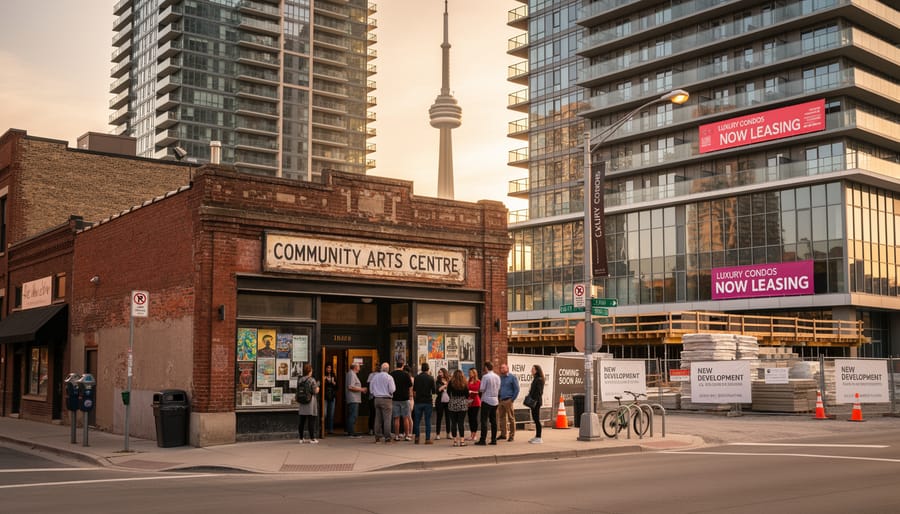
Toronto’s cultural identity exists precisely within its contradictions. The city that celebrates multiculturalism through festivals and public policy simultaneously grapples with persistent segregation across neighborhoods and economic divides. It welcomes innovation and architectural transformation while displacing long-established communities and cultural landmarks. These tensions aren’t flaws to be resolved but rather the dynamic forces that continually reshape what Toronto means to its residents.
Understanding these contradictions requires more than passive observation. The future of Toronto’s culture depends on residents actively engaging with their communities—attending local events beyond the marquee festivals, supporting independent cultural venues, and participating in city planning consultations that determine neighborhood character. It means questioning which voices are amplified in cultural narratives and which remain marginalized, recognizing that authentic multiculturalism requires more than coexistence.
Critical awareness matters equally. Residents can scrutinize development proposals that threaten cultural spaces, advocate for affordable housing that allows diverse communities to remain rooted in their neighborhoods, and challenge cultural commodification that reduces lived experience to tourist spectacle. The city’s cultural evolution isn’t predetermined by market forces or municipal plans alone—it emerges from countless individual choices about where we spend our time, money, and attention.
Toronto’s culture will continue to be defined by negotiation between competing visions and values. Those willing to engage thoughtfully with these complexities, rather than accepting simplistic narratives, will shape whether the city’s diversity remains a lived reality or becomes merely a brand.